Master’s students design solutions to combat alarm fatigue in OLVG’s A&E department
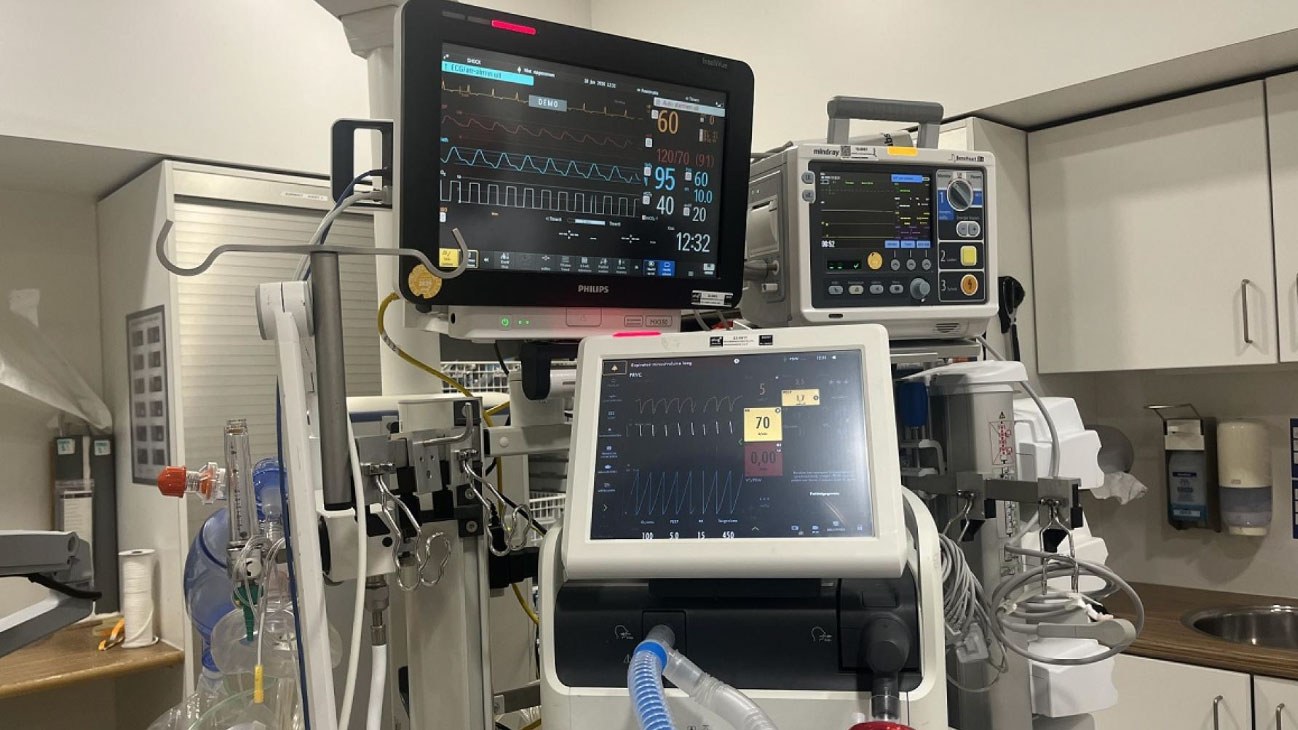
How do you reduce the constant stream of beeps and alerts in one of the busiest departments in a hospital? Students of the Master’s degree programme in Digital Design at Amsterdam University of Applied Sciences (AUAS) set themselves the task of addressing this issue, in cooperation with the Accident and Emergency department at OLVG Oost. They have come up with a number of solutions to combat ‘alarm fatigue’ among nurses and doctors.
Nurses, doctors and patients in busy hospital departments, such Accident and Emergency and Intensive Care, are continuously exposed to a cacophony of beeps, signals and alerts from medical equipment. Many of these notifications are unnecessary. This is because the alarm thresholds on equipment – from oximeters to patient monitors – are not always adjusted to the patient, as care providers are already very busy. However, the excessive noise is now leading to ‘alarm fatigue’: care providers are becoming overwhelmed, with the risk that important signals may be missed.
‘The aim was to reduce cognitive overload in the A&E department,’ explains Danique van der Arend, an A&E nurse and quality officer at the OLVG hospital. ‘Alarm fatigue is a well-known problem in hospitals. Fortunately, it’s receiving increasing attention. The Jeroen Bosch hospital, for example, has carried out a successful project to reduce the number of unnecessary alarms. We wanted to do something about this, too. That’s why two nursing students – who have since graduated – drew up a protocol for our A&E department to reduce the number of alarms. However, implementing this protocol is the real challenge. Raising awareness among care staff about this would be a useful first step.’
Guided Tour
The students set to work on this challenge. They visited the A&E department three times, during which visits they were given a guided tour and closely observed the department, including all the monitoring equipment. Students then worked in teams to create a number of prototypes, on which the doctors, doctors in training, nurses and the quality officer involved provided their feedback. This has led to four final ideas:
* A serious game, in which care providers learn to prioritise under time pressure. In this game, you have to treat patients in the correct order, despite the alarms going off. ‘It’s very well made,’ OLVG’s Danique gushes.
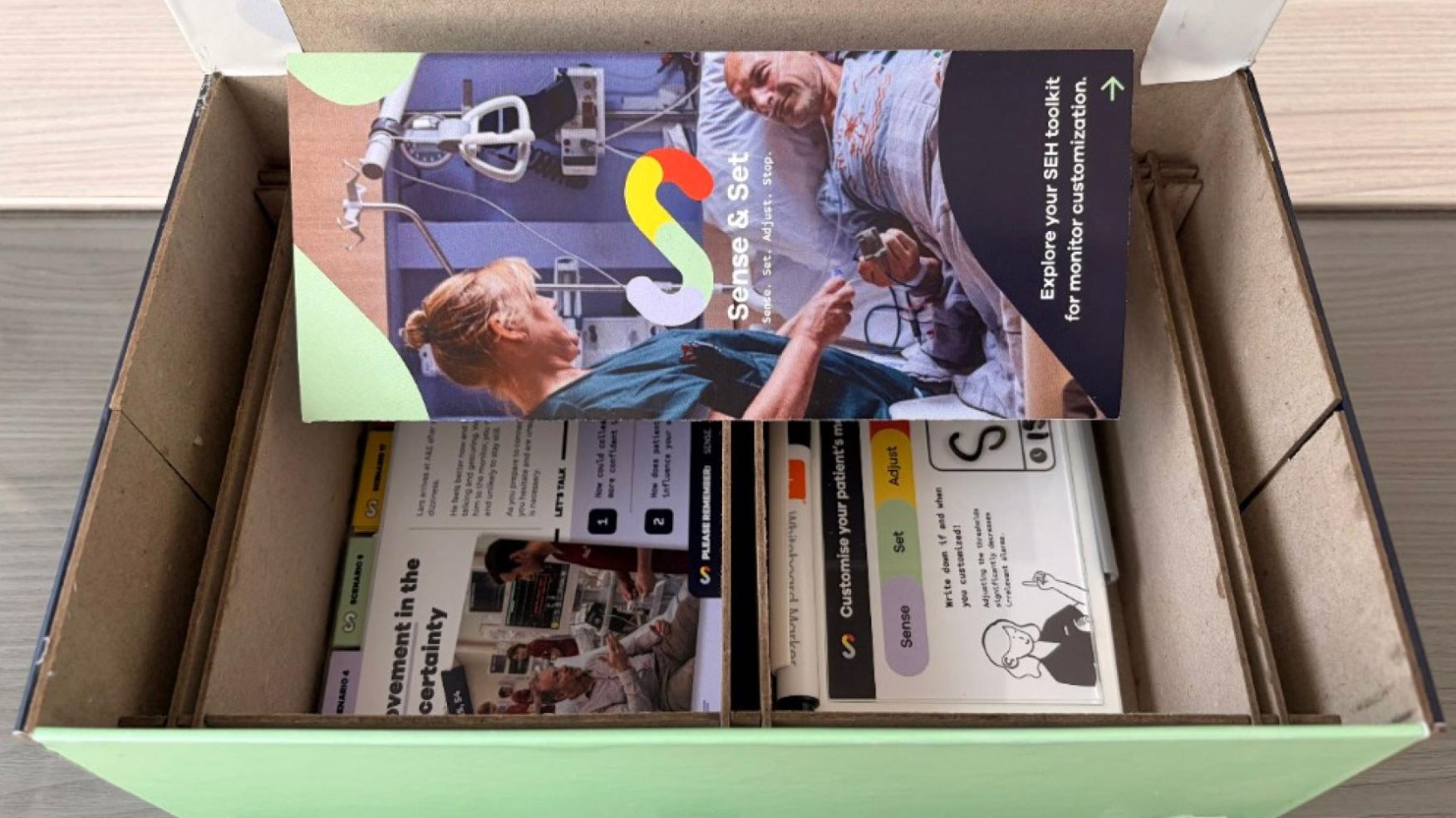
* A toolkit, which in principle could be kept in the staff room of any A&E department. It contains posters, reminder cards to put on monitors and a game that encourages care providers actively to adjust alarm thresholds.
* A central overview screen, on which care providers can see at a glance which monitors have already been configured for the patient and how this has reduced the number of alarms. Students are currently exploring the possibilities for further development with monitor manufacturer Philips.
* A physical design using wooden pegs. The peg will rise if the relevant patient has not been seen for some time. As soon as a care provider visits, they push the peg down again. The design makes visible which patients need attention. Danique: ‘This helps to raise awareness in a humorous way: do you have an accurate overview of your patients and colleagues?’
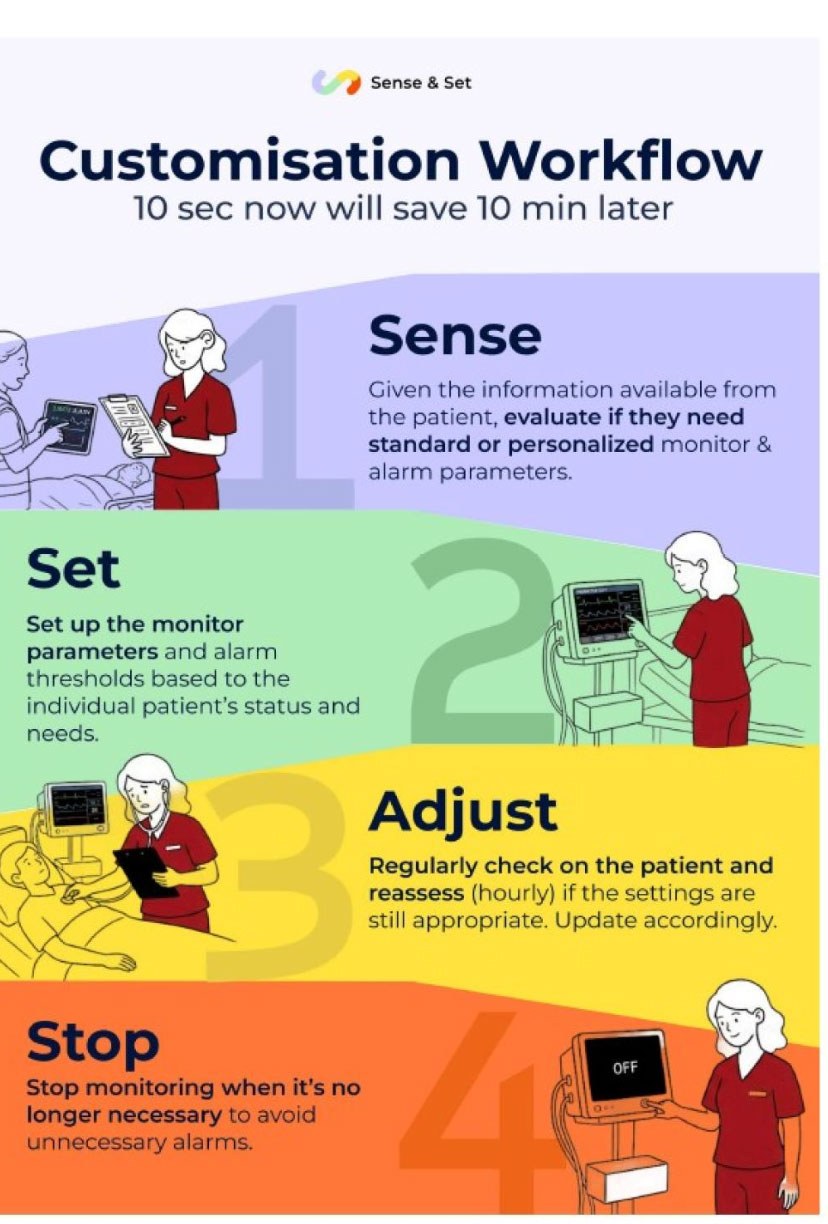
The solutions took Danique and her colleagues by surprise. They put the toolkit to good use straight away. Master’s student Damian Westerborg contributed to this project. ‘For new nurses, the protocol can be a bit much, so we simplified it into a four-step model that we then based the whole toolkit on.’
The toolkit contains small-scale interventions that are designed primarily to make things easier for care providers, such as reminder cards to put on monitors that you can write your initials on and the time at which you adjusted the alarm threshold. It also comes with a poster that clearly explains the steps in the protocol.
In addition, the toolkit includes a game with 32 scenario cards, designed to encourage cooperation and team communication. This is a fun activity for care providers to do during education and training sessions.
The posters are now on display in A&E, as Damian saw when he returned recently. They work really well, says Danique. ‘And on weekdays, we always have a 30-minute clinical training session, during which the scenario cards make for a good way to start a conversation in a playful way. After all, monitoring the alarms is a shared responsibility.’
The student team will soon be pitching their concept to OLVG’s management as well.
Not just digital
Interestingly, the students did not opt for a new app or digital application. ‘In our research, we learned that care providers sometimes have to log in to as many as four different programmes just to carry out a single procedure,’ says Damian. ‘We realised that, if we added yet another system, we would only increase the cognitive load. That’s why we focused on something that doesn’t take too much energy and is all about cooperation.’
Nevertheless, this project clearly illustrates the role of designers, says Damian. ‘The most important thing is to learn to think from your target audience’s perspective and to listen carefully.’ Danique observed this as well: ‘It was surprising how much the Master’s students noticed during their visits to A&E. They were very keen observers.’